ONE ENGINE · FOUR COCKPITS

Your mission.
AI-amplified.

The AI command centre for mission-driven work — Learn, Make, Run — on infrastructure you own and govern.

Your mission, delivered — and kept on course.

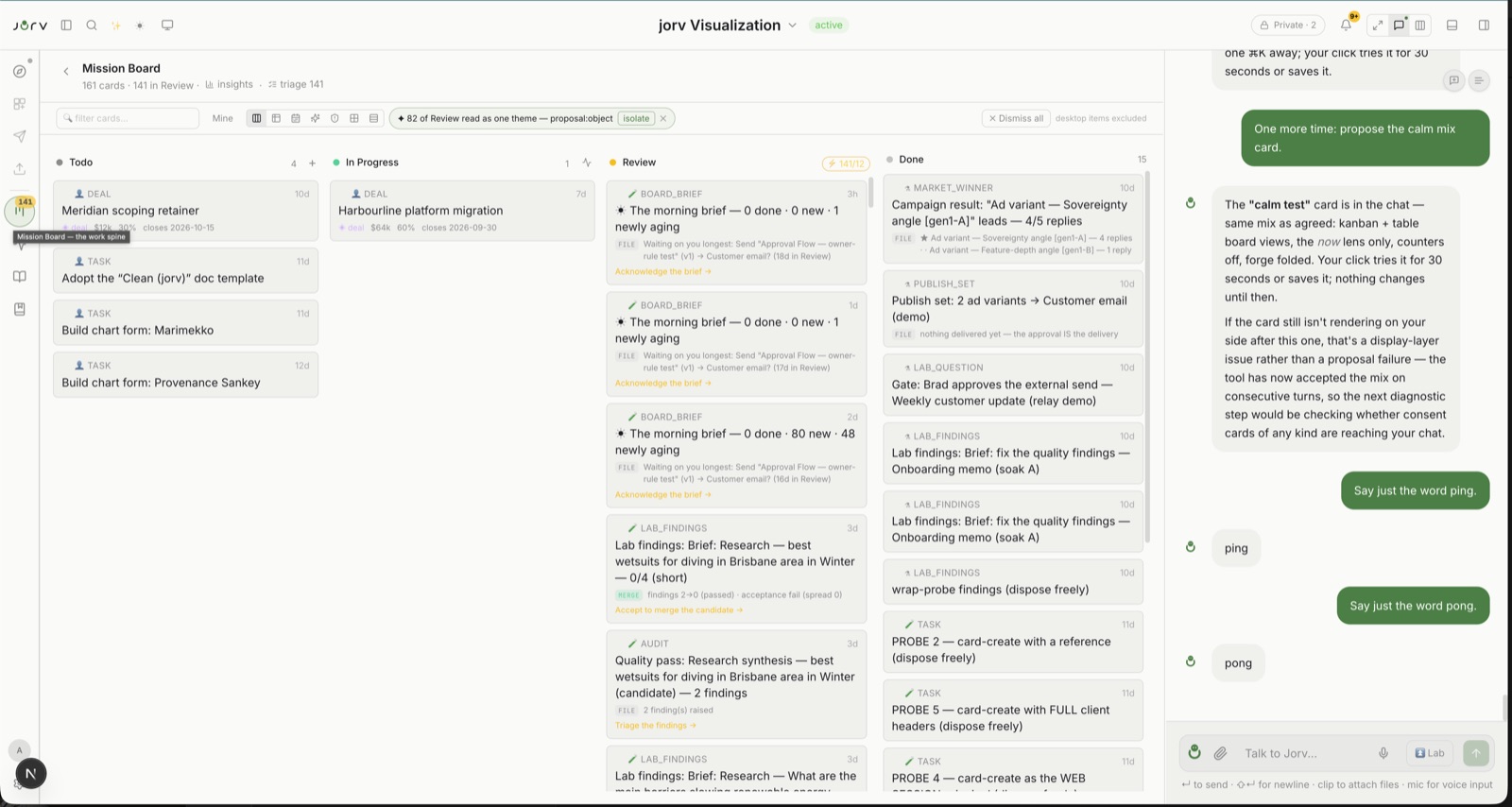
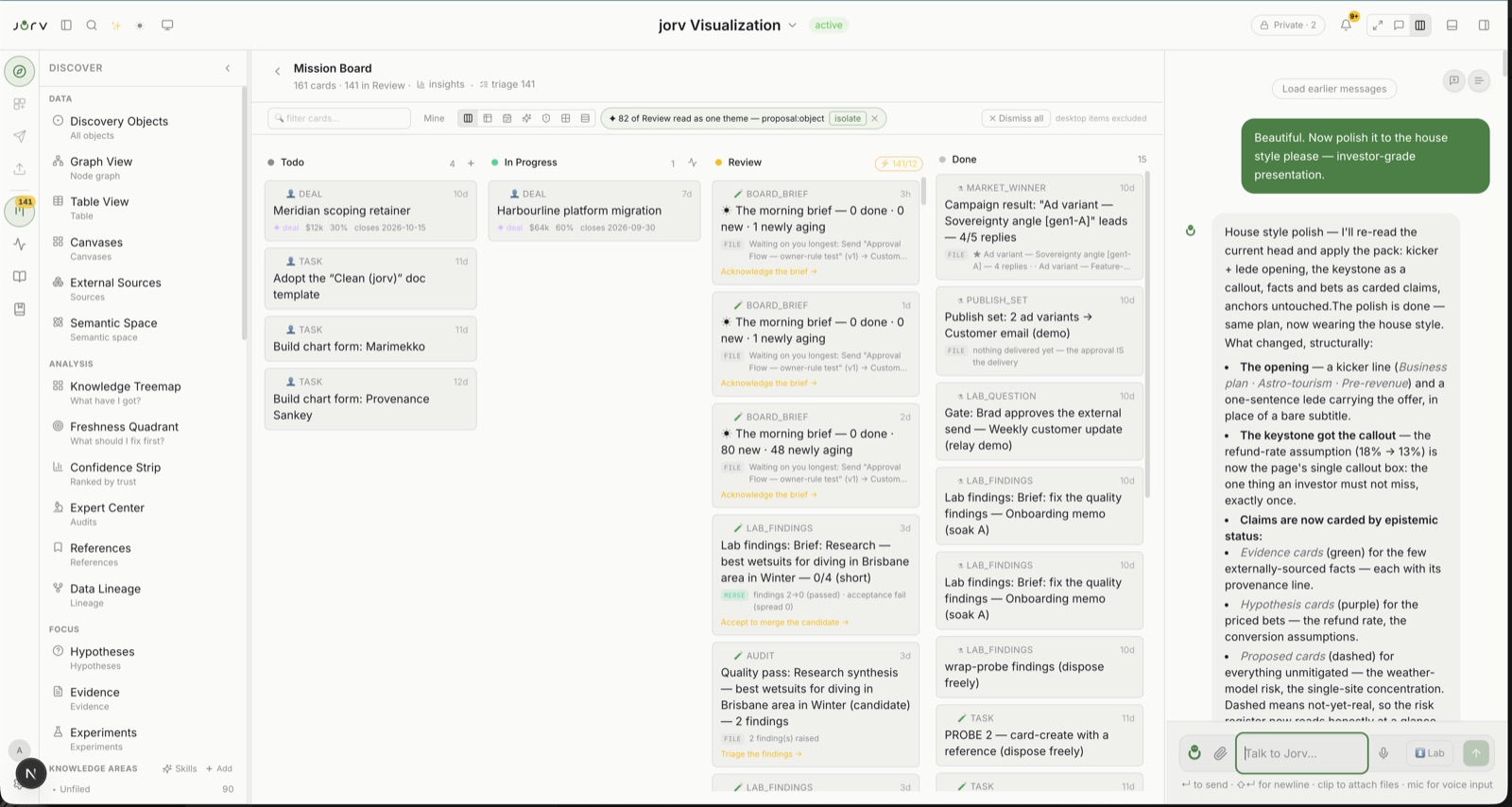
▶ Media — the Mission HUD cockpit / Mission Board: live agents and Lab loops running, items moving into Review. The namesake heads-up view.

The problem

Stop being the glue.

AI has made individuals dramatically faster. Yet most organisations capture almost none of it — because the work is scattered across hundreds of disconnected tools, and you are the glue holding them together. Each has its own database, its own login, its own mental model; at every handoff, the intent — the why — is left behind.

0

apps per large enterprise

0%

actually integrated

0 min

to refocus after a switch

$0.0T

lost to complexity, annually

Sources: MuleSoft Connectivity Benchmark 2026 · Gloria Mark, UC Irvine · IDC / Gartner estimates (directional)

Apps as prisons for thought.

The tools were never the point. They exist because, until now, no one could hold the whole thread across them. That just changed.

The collapse

One brain for your whole mission — not 305 tools.

One engine — ORBIT — holds a single graph of everything you know, decide, build, and run, and one AI reasons across all of it. The four cockpits are lenses onto that one brain. Complexity isn’t managed. It’s collapsed.

Discovery
Learn

Discoverywhat's true, and how sure are we?

Business
Run

Businesshow is the mission performing?

ORBIT EngineThe engine

ORBIT Engine

One graph · one memory · one intelligence · one governance · one audit. The cockpits orbit it.

Builder
Make

Builderwhat should we build, and does it work?

Designer
Design

Designerwhat should it look & feel like?

We didn’t build four products. We built one methodology and pointed it at four kinds of work.

The structure is identical across domains — only what you measure changes.

The dynamic

Alignment → Simplicity → Supernova

For the first time, AI lets you collapse complexity instead of managing it. Align the mission, the work, and the system — and capability is released.

Step one

Alignment

Mission, work, and substrate pull in one direction. One graph, one source of truth — what you discover, build, and run, all on the same foundation.

Step two

Simplicity

Complexity collapses. The noise clears; what was tangled becomes navigable; what was invisible becomes a lens.

Step three

Supernova

Capability is released. Self-improvement compounds and the work crosses from linear to exponential — mission-led, AI-amplified.

The gains compound:

Focus

amplified

Cost

collapsed

Quality

amplified

Time

compressed

Capability

amplified

Meet the cockpits

Four cockpits. One reality.

Each cockpit is a lens and an operator over the same graph — contributing its own work types and its own execution, sharing one engine, one governance, one audit.

Available · early
Discovery · Learn iconDiscovery · Learn

A reasoning engine for any mission.

From question to evidence to insight.

Point Discovery at anything you're pursuing — a company strategy, a research question, a renovation, your own health. Everything you capture becomes a claim with a confidence and a source; Discovery reasons across all of them, matures questions into evidence and insight, and flags the contradictions, risks, and opportunities you'd never spot by hand. Nothing is ever treated as certain — only investigated, and revised as the evidence changes.

From a personal knowledge area to an entire business — one reasoning engine, fully governed.

Mature · in production
Builder · Make iconBuilder · Make

Stay on your mission. The cockpit handles the rest.

The dev cockpit that never loses the plot.

Your whole toolchain, AI, audits, and code behind heads-up displays. Every change starts with a brainstorm and ends traceable from contract to commit to production — glass box, not black box.

Replaces: the AI-IDE + CI + audit + deploy stack

Coming 2027
Business · Run iconBusiness · Run

Run the whole business from one brain.

Replace ~50 fragmented tools with one operating system.

Marketing, sales, education, and support as one actor lifecycle over one event stream — no handoffs between systems. Every campaign and playbook is a testable hypothesis. Seven views answer seven questions about the business.

Replaces: CRM + marketing automation + LMS + helpdesk

In Figma · deepening
Designer · Design iconDesigner · Design

Design that never drifts from the build.

AI-native design, in sync with the code.

A Figma-native cockpit that shares one source of truth with Builder — so design and code can't quietly diverge. The bridge between a mission's intent and the product that ships it.

Replaces: design-to-code & UI-generation point tools

Plus AppSpec, the open standard the family runs on.

The arc

One engine, the whole arc.

The whole company runs one loop — discover, design, build, deploy, run, learn — and the mission evolves. Most stacks hand that loop between tools, and every handoff amputates the intent. Mission HUD runs it as one engine with four cockpits over a single graph, so one intent thread carries the why from the first question to the outcome — and back into the next decision.

Discovery
LearnDiscovery
Open the loop
  • Sense & seek
  • Hypothesize
  • Research
Designer
DesignDesigner
Give it form
  • Design the form & feel
Builder
MakeBuilder
Make it real
  • Build & test
  • software · content · media
Business
RunBusiness
Face the world
  • Reach market
  • sites · SEO/AEO · social
  • Operate & support
Discovery
LearnDiscovery
Close the loop
  • Listen for signals
  • Analyze
  • Evolve the system
ORBIT EngineORBIT Engine — one graph · one memory · one governance · one audit, beneath every beat

The end feeds the beginning — every signal re-enters Discovery and asks: does this still match the mission?

Other tools own the slices. Mission HUD owns the seams — one intent thread that survives every handoff, the whole way round.

How the family is different

To match the family, you either glue or surrender.

To cover what one Mission HUD family covers, you either stitch together best-of-breed tools and become the glue — four memories, four governance models, four audits — or adopt a big-vendor AI suite that is more integrated, but cloud-locked and vendor-governed. No alternative gives you one graph across the whole lifecycle, on infrastructure you own.

Built-in Partial / scoped Add-on / external Not by default
CapabilityBest-of-breed stackNotion · Cursor · Figma · HubSpotBig-vendor AI suiteM365 Copilot · Gemini · AgentforceHorizontal agent platformCopilot Studio · AgentKit · n8nMission HUD
family
One brain across the work
One knowledge graph / semantic fabric across the whole lifecyclea
Shared memory across discover → design → build → run
The whole lifecycle in ONE product (not an assembled suite)b
Governance, trust & audit
One governance + permission model across every domainc
Permission-aware AI retrieval by constructionc
Tamper-evident / append-only audit lineaged
Sovereignty & control
Self-host / on-prem / air-gapped — the whole producte
Bring your own LLM (incl. a local model)f
No vendor usage or visibility into your contentg
Method
One methodology gate — human approves before any change

aMicrosoft OneLake/Fabric is positioned as a "single source of truth" but is scoped to analytics data; line-of-business app data is connected by reference, not consolidated (Microsoft Learn, 2026).

bThe closest, Microsoft, spans much of the lifecycle — but across many separately-licensed, separately-governed products, not one cockpit.

cPurview enforces permission-aware retrieval and captures Copilot prompts/responses — within the Microsoft 365 estate only (Microsoft Learn, Jun 2026). Agent 365 governance groups policies from separate control planes (Entra/Purview/Defender/SharePoint), GA May 2026.

dUnified audit logs are common; tamper-evident / append-only lineage is not claimed by any competitor source. EU AI Act Article 12 (in force 2 Aug 2026) mandates lifetime logging — record-keeping, not tamper-evidence.

eGenuine but scoped: Microsoft’s disconnected stack (Azure Local + M365 Local + Foundry Local, GA Feb 2026) and Google Distributed Cloud air-gapped (disconnected Gemini, Aug 2025) host infrastructure / on-prem servers — not the cloud Copilot or Agentforce cockpits themselves. Some single tools self-host; the assembled suite does not.

fOffered only via separate developer paths or as a distinct "bring your own model" option — not as the core product (Salesforce, Microsoft, 2026).

gCloud suites route content through vendor-hosted LLMs; Salesforce relies on contractual zero-data-retention. Google GDC air-gapped (billing computed locally, not visible in the Google console) is the notable exception — but it is infra hosting, not a cockpit.

Assessed by category from public vendor documentation as of June 2026; individual tools vary and the big vendors are actively closing gaps. Mission HUD capabilities reflect the ORBIT architecture across the family; cockpits ship on a roadmap (Builder available · Business arriving 2027).

Why it’s called ORBIT

Everything orbits the mission.

Your mission is the centre of gravity. Every action stays bounded to your intent, so the AI amplifies direction, not drift.

Around it, a broad fleet of expert agents and goal-seeking loops do the work — researching, building, auditing, designing, writing, producing, marketing — autonomously, even while you sleep. They always propose; you always decide. Nothing drifts off-mission; nothing changes without you.

OpportunityHypothesisExperimentOutcomethe Mission evolves
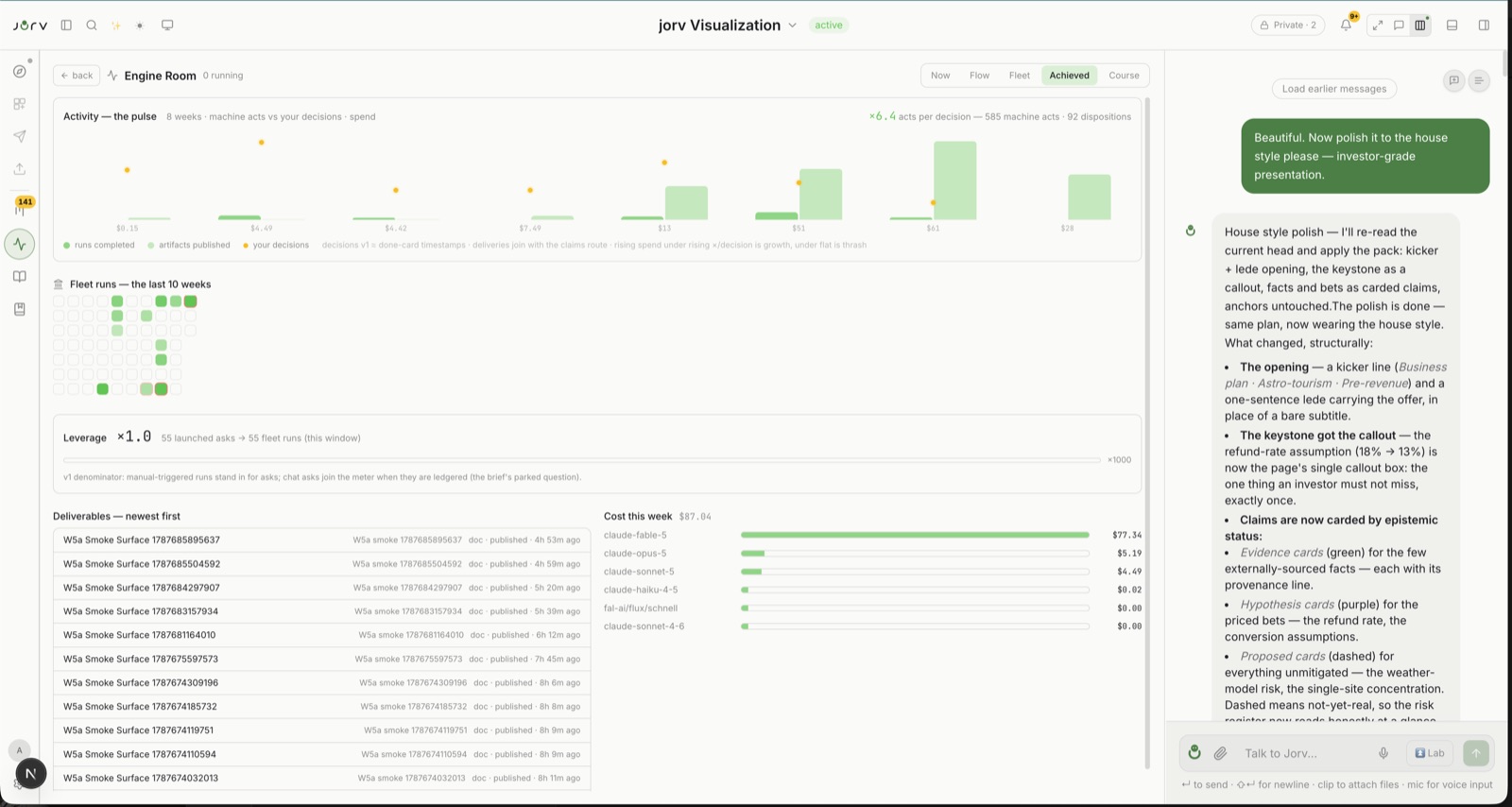
▶ Media — the Expert Centre: run any expert on demand or on a schedule; findings arrive as Review cards on the Mission Board.

A broad, extensible fleet

ResearchCodeSecurityAccessibilityPerformanceArchitectureTestingDesignCopyImagesVideoVoiceCampaignsOutreachSupport+ bring your own

Orchestrated

You direct; the system runs parallel streams.

Reliable

Glass box, audit trails, bounded autonomy.

Bounded

Your mission defines the playing field.

Intent

Say what you want — no translation layer.

Tasks

Everything decomposes into measurable units.

The workflow · 1.0 – 4.0

You lead. AI amplifies.

One loop powers every cockpit — Brainstorm, Agree, Build, Verify — and nothing touches reality until you say so. AI proposes; you dispose.

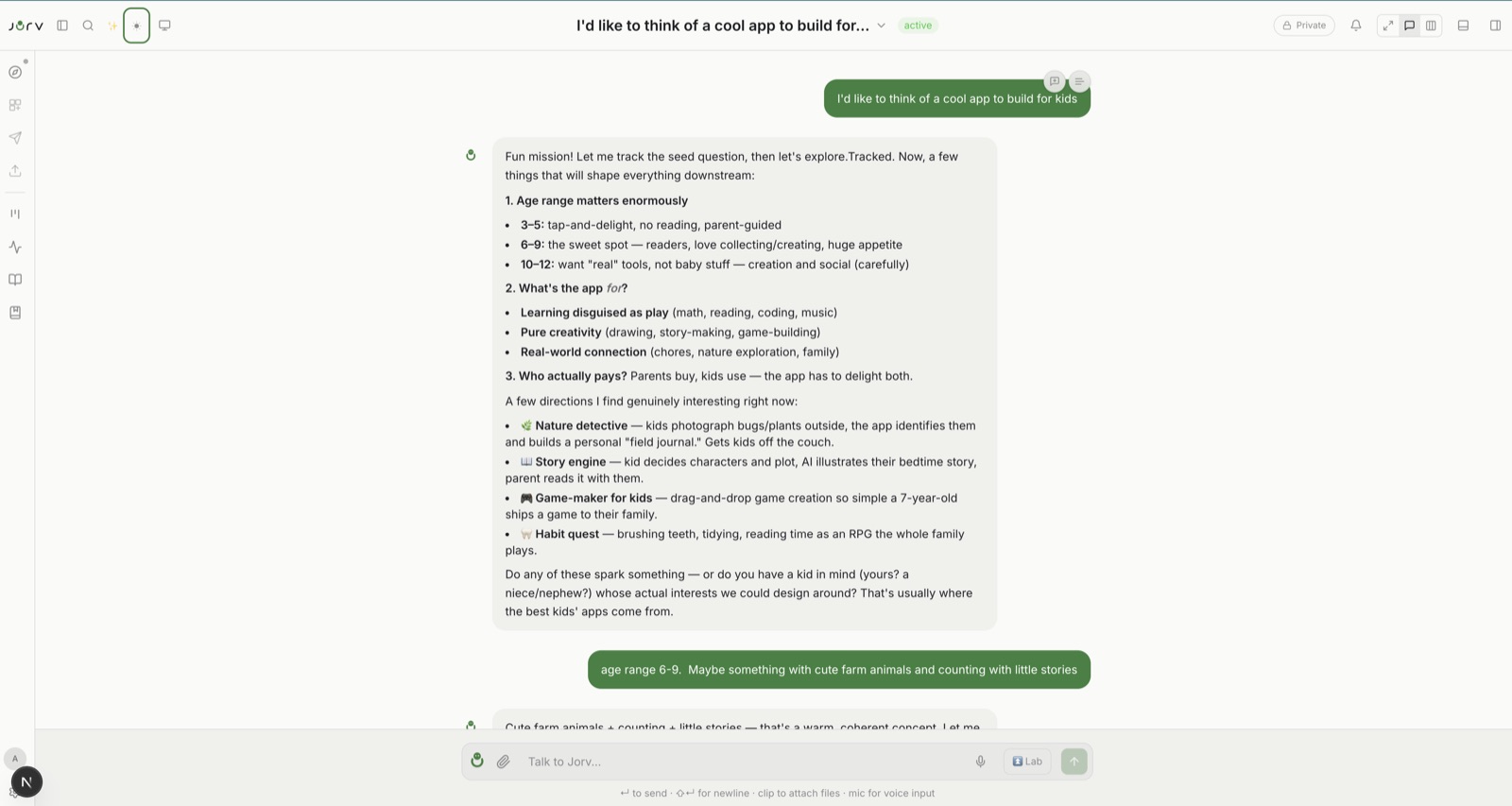
▶ Media — the BABV workflow in motion: Brainstorm → Agree (run here, or in a Lab) → an autonomous goal-seeking Lab loop → the result lands in Review.
1.0

Brainstorm

Align on the approach against the mission, with the AI as a thinking partner. A card is created if none exists.

2.0

Agree

Confirm where it runs — here with you, or autonomously in a Lab. Goal-seeking Labs iterate while you sleep. Nothing mutates before the gate opens.

3.0

Build

Agents execute in parallel, in isolation, bounded by the mission — always visible on the Mission Board, reporting through the Glass Box.

4.0

Verify

The plan runs, the result is scored against the hypothesis that justified it, and it lands as a Review card for you to approve.

Autonomous or hands-on, every run is visible on the Board and ends in Review. Nothing ships without you.

The control

On your infrastructure. Under your governance. Provable by audit.

Bring your own everything. Your infrastructure, your LLM — down to a local model on your own hardware. Self-hosted, or fully air-gapped where the work demands it.

Governed from the ground up. Who can see and decide what is enforced inside the engine, not painted on by the interface. The AI is filtered by the same permissions as any person — retrieval is permission-aware by construction.

Audit-ready by construction. Every decision and access is recorded in a tamper-evident, append-only lineage — the kind of traceability regulators are moving toward (EU AI Act record-keeping among them). Don’t just log it. Prove it.

Zero vendor surveillance. We don’t know what you build or how much you use it. The only thing that ever crosses the boundary is a licence — a licence id and a timestamp. That’s the whole payload.

Sovereignty is placement

1
Your laptopsolo, a personal sidecar engine
2
Your LAN / datacentrea shared team engine
3
Your cloud accountyour tenancy, your keys
4
On-prem / air-gappedregulated & sovereign — intact

Same product, same code path at every placement. Sovereignty is a deployment choice, never a fork — and never a vendor-run tier holding your data.

▶ Media — the audit / lineage trail: every decision and access, hash-chained and replayable — Article-12-grade.

Who it’s for

From solo & founders to large entities.

One product, scoped to what you need — the same engine wherever it’s placed.

Solo & foundersA personal mission or a one-person company — a whole team's output, solo.
Teams & startupsCollapse the tool sprawl before it collapses you.
EnterprisesOne sovereign graph, one governance model, one audit — across every function.
Government & regulatedAir-gapped, provable, accountable. Built for the strictest rooms.

The thinking behind it

This isn’t a feature pitch. It’s a worldview.

Mission HUD is the working expression of a researched argument: complexity is the root cause of enterprise failure, and AI makes it possible — for the first time — to collapse that complexity rather than manage it. We’ve written it down, openly, in full.

A seven-essay series · part of the Unified Framework trilogy

Your mission, delivered —
and kept on course.